Raileon
A platform that sets up and runs automations for small businesses. I'm one of the two developers who maintain it.
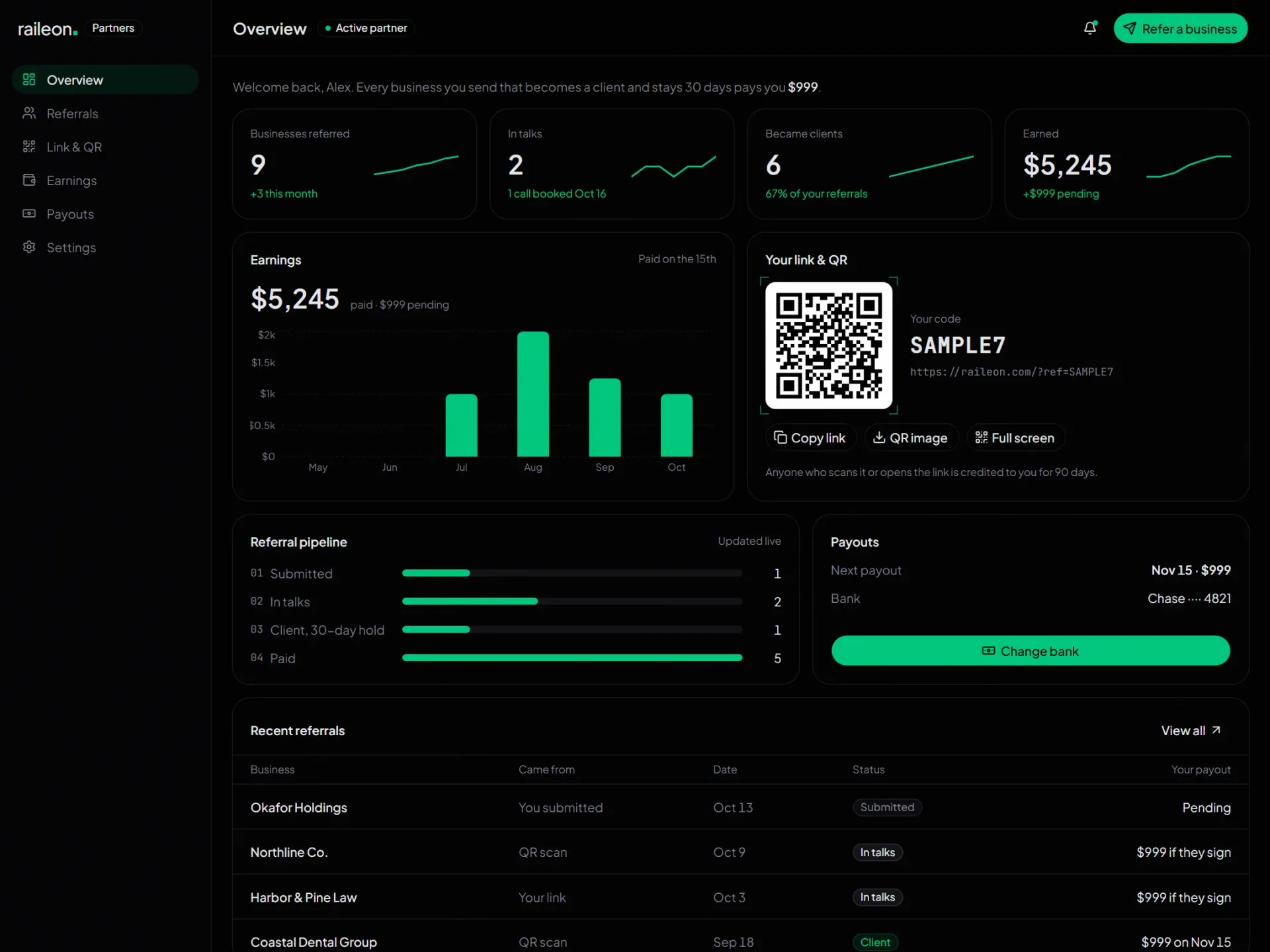
Raileon gives each business its own workspace, with a dashboard, connections to the tools they already use, chat channels, automations and billing. There are two of us maintaining the whole codebase.
What I did
- Set up the frontend and its design system, and built the admin console and initial tenant dashboard.
- Built the adapters that connect a client's Discord or Telegram to their workspace, along with the shared package they use.
- Set up one-click production deploys, scheduled backups and a weekly test that restores a backup.
- Tightened up the production setup and made the security checks in CI required.
- Set up and maintain our servers and deployed our backend.
- One of two maintainers
- 2026, ongoing
- Next.js on Vercel
- FastAPI, Redis workers, Docker
Built with
- Next.js
- TypeScript
- Python
- FastAPI
- Convex
- Redis
- Docker
- Stripe
- GitHub Actions
- Playwright
A workspace per client
Each workspace runs in its own sandboxed container, with an encrypted volume, its own network and its own resource limits. Connections to tools like Gmail, Slack and Google Calendar are kept in a vault, where each credential belongs to one client and one provider.
Workspaces go through set stages, from being created to being archived. If one is cancelled, nothing is deleted for seven days.
Chat channels
The adapters connect a client's Discord or Telegram to their workspace. They all use the same shared package, so sign-in, message format and safety checks work the same way on each platform.
Each message is only handled once, even if the platform sends it twice. Every channel also has a spending cap, and the channel stops if the cap can't be checked.
Backups and testing
Backups are encrypted, and a scheduled job restores them to make sure they actually work. The backend has over 1,000 tests, and end-to-end, security and schema checks run in CI.